The traditional coding interview—the whiteboard, the algorithm puzzle, the LeetCode grind—has been a gatekeeping ritual in tech for decades. But as AI coding agents like GitHub Copilot, Claude Code, and others become integrated into daily development workflows, we’re facing a fundamental question: What should we actually be testing in a coding interview when AI can write the code?
The Shift: From Algorithm Memorization to AI Collaboration
For years, candidates have spent countless hours practicing algorithm problems on platforms like LeetCode, memorizing patterns, and optimizing their ability to solve contrived puzzles under time pressure. While these skills demonstrate problem-solving ability and computer science fundamentals, they often have little correlation with day-to-day engineering work.
Enter AI coding agents. Today’s engineers increasingly work with AI tools rather than writing every line of code from scratch. This reality is forcing us to rethink what competencies we should evaluate during technical interviews.
The New Interview Format: Live AI-Assisted Problem Solving
Imagine an interview where instead of asking a candidate to implement a binary search tree from memory, you provide them with:
- A real-world problem or feature request
- Access to AI coding agents (Claude Code, Copilot, ChatGPT, etc.)
- A limited time window
- An evaluator watching their process
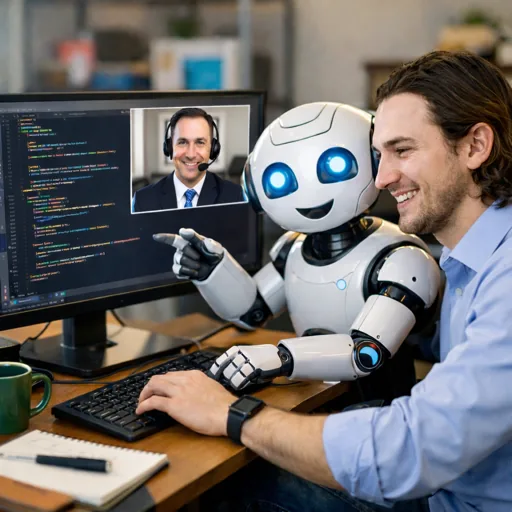
The goal isn’t to see if they can write perfect code without help—it’s to observe how effectively they collaborate with AI to solve problems. This might include:
Breaking Down Projects into Actionable Work
One critical skill is the ability to decompose a complex project into manageable pieces. In this new interview format, candidates might be asked to:
- Use AI planning modes to analyze a project and identify technical requirements
- Create Epics, Stories, and Tasks in Jira (or similar tools) that represent a realistic breakdown of work
- Demonstrate understanding of how to structure work for a team, not just for themselves
This tests architectural thinking, project management skills, and the ability to communicate technical concepts—all more valuable than memorizing how to balance a red-black tree.
Efficient Use of Research and Agent Modes
Modern AI tools offer different modes of interaction:
- Planning mode: For breaking down complex tasks and designing approaches
- Research mode: For exploring codebases and understanding existing patterns
- Agent mode: For autonomous task completion with oversight
A strong candidate would demonstrate:
- When to use each mode appropriately
- How to provide clear context and constraints to the AI
- How to validate and review AI-generated solutions
- When to course-correct if the AI goes off track
Collaborative Workflow with Pull Requests
Rather than writing code in isolation, candidates might:
- Work with an AI agent to implement a feature
- Create a pull request with proper documentation
- Review their own code critically, identifying potential issues
- Respond to feedback (perhaps from the interviewer playing the role of a code reviewer)
This simulates real team dynamics and tests communication skills, code review abilities, and understanding of software development best practices.
The LeetCode Era: Coming to an End?
LeetCode-style interviews have long been criticized for:
- Poor correlation with job performance: Being good at algorithm puzzles doesn’t guarantee you’ll be a productive team member
- Bias and accessibility: They favor candidates with time and resources to practice extensively
- Stress-inducing: The artificial pressure rarely reflects real work conditions
- Narrow skill assessment: They test a slice of computer science knowledge while ignoring collaboration, communication, and practical engineering skills
With AI capable of solving most LeetCode problems in seconds, these interviews become even less relevant. Why test whether a human can implement Dijkstra’s algorithm when:
- AI can do it instantly
- The real skill is knowing when to use such an algorithm
- Production code is about maintainability, collaboration, and business value—not algorithmic perfection
The Ethics Question: Is Using AI “Cheating”?
This shift raises thorny ethical questions:
During the Interview
If interviews explicitly allow AI tools, is it ethical to:
- Use AI to solve problems you don’t fully understand?
- Present AI-generated code as your own work without acknowledging the assist?
- Rely entirely on AI without demonstrating any fundamental knowledge?
The counterargument: If AI tools are standard in the job, using them during the interview is simply realistic preparation. The question becomes whether the candidate can effectively leverage these tools, not whether they can work without them.
The Skill vs. Tool Debate
There’s a valid concern that over-reliance on AI could create engineers who:
- Can’t debug when AI makes mistakes
- Don’t understand the fundamentals behind the code they ship
- Struggle when AI tools are unavailable or inappropriate
However, this mirrors historical debates about:
- Calculators in math class
- Stack Overflow in professional development
- IDE autocomplete features
Each time, the profession adapted. Fundamental understanding remained important, but the expression of that understanding evolved.
Setting Clear Expectations
The ethical path forward requires:
- Transparency: Interviews should clearly state whether and how AI tools can be used
- Understanding verification: Candidates should be able to explain AI-generated code and justify architectural decisions
- Fundamental knowledge: Some baseline understanding of computer science principles remains necessary
- Honest self-assessment: Candidates should accurately represent their skills and acknowledge when they’re working at the edge of their knowledge with AI assistance
What This Means for Candidates
If you’re preparing for interviews in this new landscape:
Develop AI Collaboration Skills
- Practice using different AI coding agents effectively
- Learn to prompt clearly and provide good context
- Understand how to validate and review AI output
- Get comfortable debugging AI-generated code
Don’t Abandon Fundamentals
You still need to understand:
- Basic data structures and algorithms (even if AI implements them)
- System design principles
- How to read and reason about code
- Debugging strategies and problem-solving approaches
Build Real Projects
The best preparation is building actual software with AI tools:
- Create side projects using AI agents
- Practice breaking down features into tasks
- Work with version control and pull requests
- Learn to write clear documentation
Practice Communication
As coding becomes more automated, your ability to:
- Explain technical decisions
- Collaborate with team members
- Understand business requirements
- Communicate trade-offs
…becomes even more critical.
The Future Is Already Here
Some companies are already experimenting with AI-inclusive interview formats. As these tools become ubiquitous, we’ll likely see:
- Standardized interview environments with approved AI tools
- Greater emphasis on system design and architectural thinking
- More pair-programming or collaborative problem-solving formats
- Assessment of “AI leadership”—the ability to direct and review AI-generated work
The shift won’t happen overnight, but the direction is clear: the future of coding interviews is less about what you can implement from memory and more about how effectively you can leverage modern tools to solve real problems.
The Bottom Line
AI coding agents are not a passing fad—they’re fundamentally changing how software is built. Our interview processes must evolve accordingly. Rather than trying to eliminate AI from the evaluation (an increasingly impossible task), we should design interviews that assess the skills that actually matter in an AI-augmented development environment:
- Problem decomposition and planning
- Effective tool usage and AI collaboration
- Code review and quality assessment
- Communication and teamwork
- Ethical judgment and professional integrity
The engineers who thrive in this new era won’t be those who memorized the most algorithms—they’ll be those who can effectively combine human judgment, domain knowledge, and AI capabilities to build great software.
How do you think coding interviews should evolve with AI? Should we embrace AI-assisted interviews, or are there fundamental skills that must be tested in isolation? What ethical guidelines should govern the use of AI in technical hiring?